

The night sky, a canvas of infinite possibilities, has captivated humanity for millennia. Today, one company, SpaceX, led by the visionary and sometimes controversial figure, Elon Musk, is not just gazing at the stars but is actively forging a path towards them.
With a relentless drive for innovation and a bold SpaceX roadmap, the private spaceflight pioneer is on the cusp of transforming our relationship with the cosmos. The SpaceX future plans are not merely about launching satellites, they are about securing humanity’s future among the stars. After all, we are all made up of dead stars that went supernova a very long time ago.
The objective starts with the ambitious SpaceX Moon missions and culminating in the audacious goal of Mars colonisation. But what’s next for SpaceX in concrete terms, and what does their ambitious timeline look like for these monumental endeavours?
Understanding this journey requires a closer look at the cornerstone of their plans: Starship.
The Colossus Starship – Humanity’s Ride to New Worlds
At the heart of SpaceX’s grand ambitions for interplanetary travel is Starship, a vehicle of truly staggering proportions and capabilities. When fully stacked, consisting of the Super Heavy booster (the first stage) and the Starship spacecraft (the second stage), it stands approximately 121 metres (nearly 400 feet) tall – towering over launch vehicles of the past.
This fully reusable launch system is designed to transport over 100 metric tons of crew and cargo to Earth orbit, and subsequently to the Moon, Mars, and potentially far beyond. This isn’t just another rocket, it’s a paradigm shift in rocket technology and the economics of space access. I mean just look at it…
The reusability of both stages is the absolute linchpin. For decades, rockets costing hundreds of millions of pounds were discarded after a single use. Starship aims to operate more like an airliner, with rapid turnaround between flights, slashing the cost of reaching space by orders of magnitude. The future of SpaceX Starship is intrinsically linked to perfecting this reusability, which is essential for achieving the high launch cadence needed for both lunar operations and the SpaceX Mars colonization efforts.
Early test flights from Starbase in Texas, while sometimes explosive, have provided invaluable data, showcasing SpaceX’s iterative design philosophy – build, fly, learn, repeat. Each test pushes the vehicle further, demonstrating increasing capabilities, from atmospheric ascent to stage separation and controlled descents. The success of future Starship missions, including achieving orbit and demonstrating in-space propellant transfer (crucial for longduration voyages), is paramount for the entire SpaceX roadmap and for enabling SpaceX deep space exploration.
First Giant Leap Revisited: The Artemis Programme and SpaceX’s Lunar Role

Before embarking on the arduous journey to Mars, SpaceX is a pivotal partner in humanity’s planned return to the Moon through NASA’s Artemis programme. SpaceX plays a pivotal role in NASA’s Artemis program, aiming to return humans to the Moon for the first time since 1972. The Starship Human Landing System (HLS) will ferry astronauts to the lunar surface, starting with Artemis III, targeted for mid-2027. This ambitious initiative aims not just to revisit the lunar surface, but to establish a sustainable human presence there, a crucial proving ground for later Martian endeavours.
What is NASA’s Artemis Program?
Artemis aims to land the first woman and the first person of colour on the Moon, specifically targeting the lunar South Pole, an area believed to be rich in water ice, a vital resource for future long-term habitats. Artemis I, an uncrewed test flight of NASA’s Space Launch System (SLS) rocket and Orion spacecraft, successfully flew around the Moon in late 2022. Artemis II is planned to be the first crewed mission, taking astronauts around the Moon and back.
The critical mission for actually landing humans is Artemis III, and this is where SpaceX’s Starship takes centre stage.
NASA selected a version of Starship as the Human Landing System (HLS) that will rendezvous with the Orion spacecraft in lunar orbit and then transport two astronauts down to the Moon’s surface, support them there for about a week, and then launch them back to Orion. This SpaceX lunar landing capability is fundamental to NASA’s near-term goals.
The SpaceX lunar landing timeline is tied to the Artemis III mission, currently targeted by NASA for September 2026, though such complex missions often face schedule adjustments. These lunar missions are more than just historical repeats, they are about testing technologies, understanding the lunar environment, and developing SpaceX plans for a Moon base or outpost. Experience gained from the SpaceX Artemis involvement in areas like precision landing, surface operations, and life support in a hostile environment will directly inform the much more complex SpaceX Mars mission architecture.
The Red Horizon: The Grand Vision of SpaceX Mars Colonisation
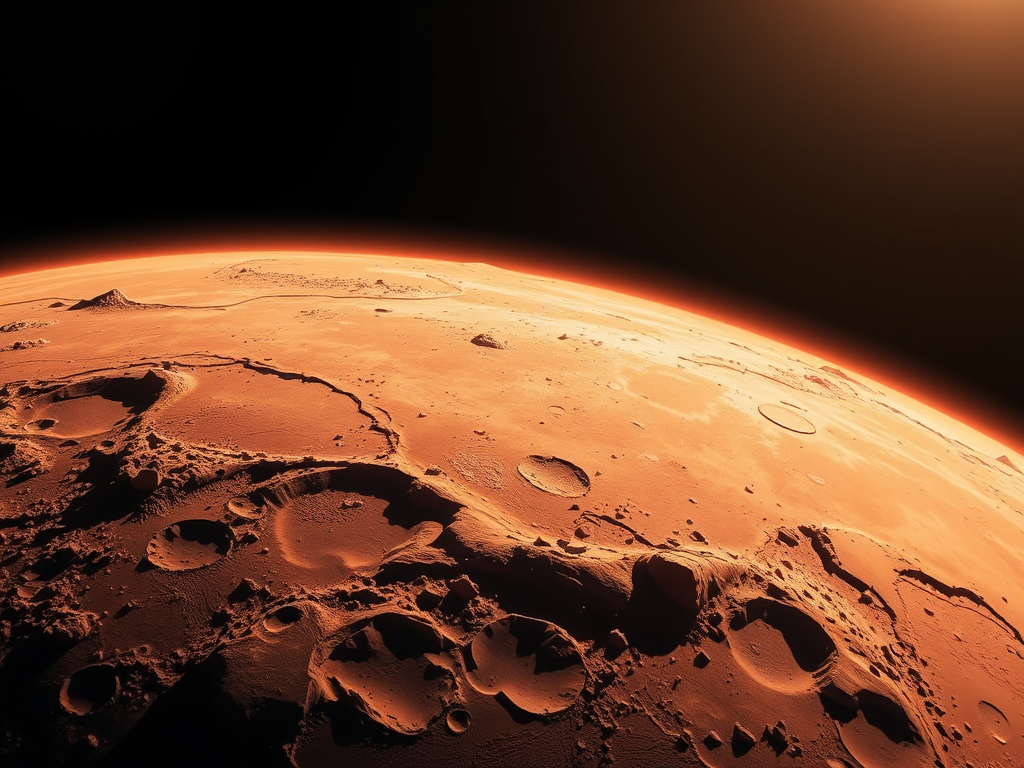
The ultimate, driving ambition for SpaceX, and particularly for real-life Tony Stark, Elon Musk, remains the colonisation of Mars. This is not just about sending a handful of astronauts on a SpaceX Mars mission, it’s a profound vision to make humanity a multi-planetary species. The rationale is to ensure the long-term survival of human consciousness by establishing a self-sustaining civilisation on another planet, a backup for Earth.
Perhaps if the Dinosaurs predicted their fate, they could have ensured their own survival on another planet had they the technology and intellect. That’s certainly a plot for a future sci-fi film if not done already… ‘Dinosaurs on Mars’.
I digress. Many understandably ask, when is SpaceX going to Mars? Musk has consistently articulated ambitious timelines, suggesting that uncrewed cargo missions to Mars, paving the way for human arrival, could occur in the late 2020s, with the first humans potentially setting foot on the Red Planet in the 2030s.
The SpaceX timeline for Mars colonisation, however, is an epic stretching over many decades, possibly centuries.
How will SpaceX colonise Mars?
The concept involves a veritable armada of Starships. Hundreds, perhaps thousands, would be launched over many years, initially carrying essential cargo such as, habitats, power systems, equipment for in-situ resource utilisation (ISRU) like extracting water ice and producing methane fuel and oxygen from Martian resources. Later Starships would carry colonists.
The challenges are almost beyond comprehension:
Life Support: Creating closed-loop systems that can sustain human life for years, millions of miles from Earth.
Radiation: Mars lacks a global magnetic field and has a thin atmosphere, exposing the surface to dangerous levels of solar and cosmic radiation. Habitats will likely need to be buried or heavily shielded.
ISRU: “Living off the land” is essential. Starships are designed to be refuelled on Mars using locally sourced methane and oxygen for the return trip to Earth. This has never been done before on another planet.
Habitats: Designing and constructing robust, pressurised habitats capable of withstanding the harsh Martian environment.
Psychological Factors: The immense isolation and confinement of a years-long journey and settlement on a distant, hostile world.
The sheer scale of the SpaceX roadmap to Mars is what sets it apart. Each successful Starship mission that deploys satellites, delivers cargo, or even tests landing manoeuvres, contributes to the knowledge and reliability needed for this grandest of goals. The challenges of Mars colonisation SpaceX is tackling are monumental, requiring breakthroughs in numerous scientific and engineering fields.
However, although the task ahead appears insurmountable, one thing is for sure, never underestimate what a group of motivated humans can do with right resources…
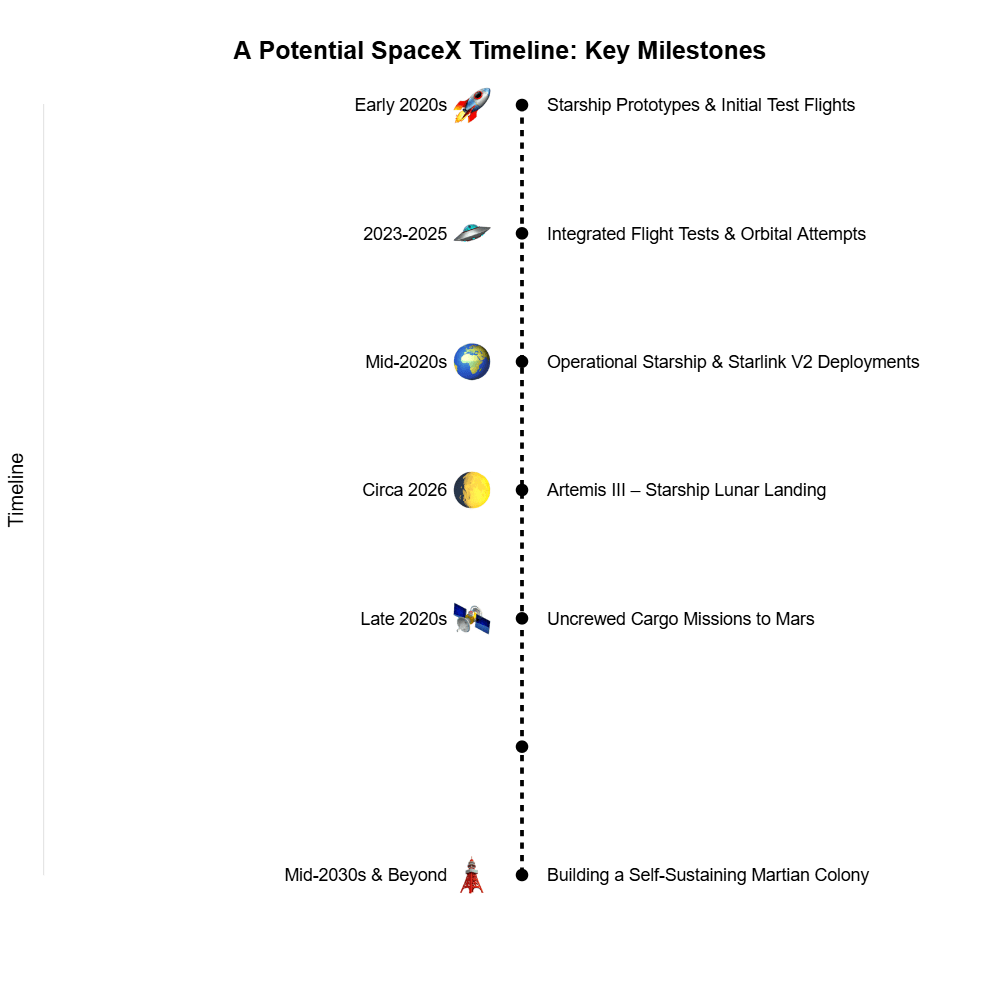
(Disclaimer: All future dates are targets and subject to change based on technological development, funding, and mission outcomes.)
Supporting Pillars: Starlink and Relentless Iteration
The ambitious SpaceX roadmap is supported by crucial parallel endeavours. The Starlink satellite internet constellation is one such pillar.
While providing global internet access, Starlink serves multiple strategic purposes for SpaceX. It generates substantial revenue, which Elon Musk has stated will be reinvested into the Starship and Mars programmes. As of early 2024, SpaceX had over 5,000 active Starlink satellites in orbit, making it the largest satellite constellation by a wide margin, providing internet to millions in dozens of countries. Starlink will also provide vital communication links for future lunar and Martian missions.
Furthermore, the iterative development philosophy – “build, fly, analyse, repeat” – remains central. Unlike traditional aerospace programmes that often aim for perfection on the first attempt (leading to very long development cycles).
SpaceX rapidly builds and tests prototypes, accepting that some tests will result in failures, which are treated as learning opportunities. This allows for a much faster pace of innovation and is a key reason why the future of SpaceX Starship has advanced so quickly. Learn from your mistakes, a saying that my old high-school teachers told me.
The Journey Awaits
The path forward for SpaceX is undeniably fraught with immense technical challenges, financial risks, and the inherent dangers of pioneering space exploration. Yet, the potential rewards of making humanity multi-planetary, unlocking profound scientific discoveries about the universe and our place within it, and providing inspiration for generations to come, are all deemed immeasurable by the company and its supporters.
The question, “What is SpaceX’s next big project?” is consistently answered with endeavours that stretch the limits of human ingenuity.
From refining Starship’s design for critical SpaceX lunar landing missions under the Artemis program to methodically laying the groundwork for the first human footprints on Martian soil, SpaceX is methodically pursuing its visionary SpaceX future plans.
As we witness the continued development of Starship and anticipate its transformative missions, we are arguably watching one of a new era in human exploration. The once distant dream of interplanetary travel and sustainable off-world settlements is being actively engineered into reality.
SpaceX is not just telling a story, it’s building it, one launch and one innovation at a time. The SpaceX timeline might be ambitious, but the journey itself is already reshaping our future in Space.
How do you find the rise in prominence of SpaceX as the Earth’s primary Space programme? Would you want to visit the Moon or Mars?
Let us know!
 Tales of Tomorrow
Leave a comment