
If you manage to put your phones down for one moment and gaze up into a clear night sky, after a few minutes or so, you will perhaps sometimes notice a tiny white star like object floating across the sky, much slower than a shooting star.If you happened to have seen this phenomenon, you might have been thinking that you were witnessing a visit from one of our alien friends.
Unfortunately or fortunately, however you may look at it, that white little object will most likely be one of the 12,000 human satellites whizzing around the earth. It’s not just empty dark sky up there, its actually getting quite busy…
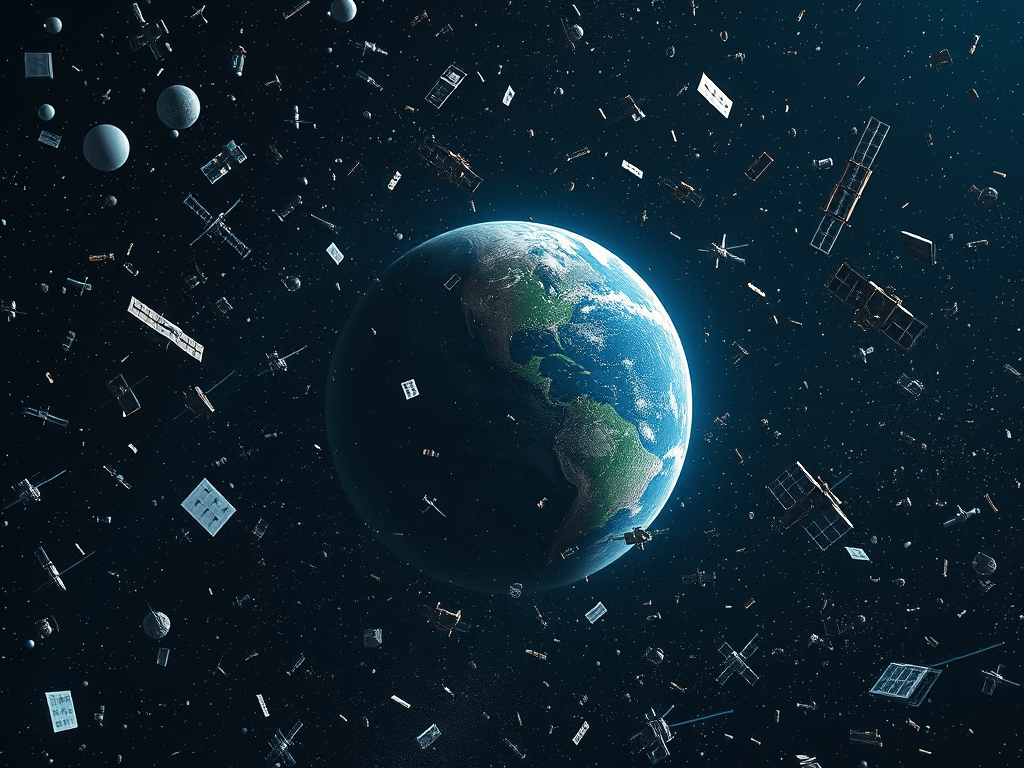
In 2025, space debris is becoming a big worry, with old satellites and rocket parts cluttering Earth’s orbit. In this week’s blog, we will take you through where we stand right now on space debris, the challenges and opportunities ahead, and how it could shape life on our planet.
(Curious about other space topics? Check out our blog on asteroid mining to see how space resources might come into play.)
The Current State of Space Debris
Space debris, sometimes called space junk, is made up of broken satellites, used rocket stages, and tiny fragments drifting around Earth. As of 2025, experts tell us there are over 54,000 objects larger than 10 centimetres up there, along with millions of smaller pieces, based on the latest orbital counts. This mess has built up over decades of space missions, leaving around 10,000 tonnes of material floating since the space age began in 1957. The global space debris market trends point to a £1.2 billion industry focused on tracking and clearing it, and that figure keeps growing as more satellites launch each year. A big mess for sure.
Big players like the USA, Russia, and China are the main contributors, with the USA accounting for about 40% of the tracked debris. Europe, through the European Space Agency, keeps a close watch on things, while India’s expanding space programme adds to the crowd. The current state of space debris affects us all, with farmers sometimes spotting pieces re-enter the atmosphere and astronomers struggling to get clear views. With over 2,000 satellites launched in 2024 alone, many for internet services such as Elon Musk’s Starlink, the problem is getting bigger. It’s creating a plethora of new jobs, such as space trackers, whilst engineers and safety experts could also flourish, showing how this is becoming a key area of work and a big cleanup process.
Space debris is dangerous for sure, it can threaten the satellites we depend on for weather updates or phone signals, and rare re-entries occasionally close airspace and disrupt flights. Schools are teaching children about looking after space, which is inspiring, and eco-groups are connecting it to pollution concerns here on Earth. With better tracking tools spreading out, even small villages are getting involved, making space debris something we all need to think about.
How Space Debris Affects Our World
Space debris brings risks that reach into our daily lives in ways we might not always notice. Consider a satellite knocked out by a speeding fragment, cutting off your TV or navigation app, which is a real possibility. Last year, the International Space Station had to dodge debris twice, showing how dangerous it can be for people up there. The film Gravity really speaks to mind in this instance!
The current state of space debris also messes with communication, since 90% of the world’s internet relies on satellites that could get hit. With this junk travelling at 28,000 kilometres per hour, orbits are turning into risky places.
Science and exploration take a hit too. Telescopes find it harder to see past the debris clouds, and new missions face higher costs to steer clear of collisions, with some saying launch expenses have gone up by 10%. Countries like the USA and China, with their big satellite networks, feel this most, but Europe and India are ramping up monitoring to protect their own systems. There’s even a worry about a cascade effect, where one crash creates more junk, blocking orbits for good.
For the rest of us, debris re-entries catch the eye. In August this year, a burn-up took place over the skies of Montana, USA, mixing amazement with a bit of concern. Hobbyists track pieces online, sharing updates, and charities are using the issue to push for greener space habits, tying it to our planet’s health. It’s clear that what happens in space has a knock-on effect down here, from flight safety to the tech we use every day.
Global Efforts in Space Debris Removal Technologies
Around the world, major nations are joining forces to deal with space debris, and removal technologies are leading the way. The USA, with NASA at the helm, runs the Orbital Debris Programme, testing nets and lasers to catch junk. This year, NASA teamed up with private companies to plan removing five large objects by 2028, which feels like a solid start. Russia, drawing on its long history of launches, uses Roscosmos to track debris and guide old satellites back to burn up, though global tensions sometimes hold back deeper collaboration.
China’s space agency, CNSA, is investing in robotic arms to grab debris, with a successful test in 2024 snagging a small piece. Europe, through the European Space Agency, is pushing the Zero Debris initiative, aiming for a clear orbit by 2030 with support from 20 member states. India’s ISRO is stepping up too, developing affordable nets for its growing satellite fleet. It’s brilliant to see this teamwork, even if differences in priorities can slow things down.
Private companies are pitching in as well. Astroscale, based in Japan, is testing magnetic docking to pull junk aside, while the UK’s ClearSpace is gearing up for a 2026 mission to capture a defunct satellite. This blend of government and business efforts shows a shared commitment, and could make a real difference as we progress to look more towards space in the future.
Future Impact of Space Debris Management

So, where is space debris heading? The future impact of space debris could reshape how we use space, and managing it is more important than ever. By 2040, the market might grow to £1.76 billion, powered by tools like nets, lasers, and robotic arms to clear the mess. Nations will need to step up, or the risks could worsen, potentially clogging low Earth orbit and stopping new satellites from launching.
The USA might take the lead with laser systems to nudge debris, while Europe focuses on sustainable launches to prevent more junk. China and India, with their expanding programmes, will likely invest in removal to safeguard their assets, and Russia could join in more if tensions ease. The future impact of space debris also affects exploration, with cleaner orbits possibly reducing collision risks by 30%, opening the door to more missions to the Moon or Mars.
Space debris management in 2025 is critical to avoid a “Kessler syndrome,” where collisions trigger a chain reaction of debris, making near space an even more deadly and treacherous environment. The UN’s Office for Outer Space Affairs is working on sustainability guidelines, but making them stick will be the challenge. If we get this right, space could stay a place for discovery and growth for everyone.
Challenges and Opportunities in Space Debris Management
There are hurdles to overcome. Only 30% of satellites follow end-of-life rules, leaving more junk behind, and tracking tiny debris under 10 centimetres is tricky, with millions still unaccounted for. The costs are steep, as clearing one object can run into £100 million, and 40% of people feel uneasy about re-entry dangers. Getting all nations to agree on rules is tough too, as priorities differ.
On the bright side, the opportunities are huge. Space debris management could save £10 billion yearly by protecting satellites, according to estimates. Safer orbits might improve internet access in remote areas by 15%, and a plethora of new jobs, such as debris trackers, whilst removal teams could also flourish. The eco-gains, like less space pollution, also support green living.
Wrapping Up with Your Thoughts
By 2040, space debris management might clear our orbits, shaping the future impact of space debris into a sustainable space age. From safer satellites to global teamwork, its potential is vast, though funding and rules need attention. The UK, alongside other nations, could lead the way in space debris trends.
We’d love to hear your thoughts! Drop a comment, would you back efforts to remove debris or are costs a concern and priorities should be bigger on cleaning up the Earth?
 Tales of Tomorrow
Leave a comment