
Unless you’ve been hiding under a rock, you’ve probably heard about tech companies like Tesla or Google, but did you know how they could soon rival entire countries? By 2030, the influence of geo-political tech giants is growing so quickly that it might challenge how nations govern and it’s already beginning to take shape.
This shift involves everything from AI cyber warfare nations to the power shift of digital currencies and even how tech regulation is shaping the future.
Let’s break it down in a straightforward way so you can understand what is happening and why it matters…
The Growing Power of Tech Titans
In 2025, companies like Apple, Google, Microsoft, Tesla, and Amazon are not just making gadgets or apps, they’re becoming global giants with more money and sway than many developed countries.
With a combined value of 10.5 trillion pounds, based on market reports from 2025, they’re rewriting the rules of power, leaving nations wondering if they’ll need to ask Siri or Google Gemini for permission to pass new laws.
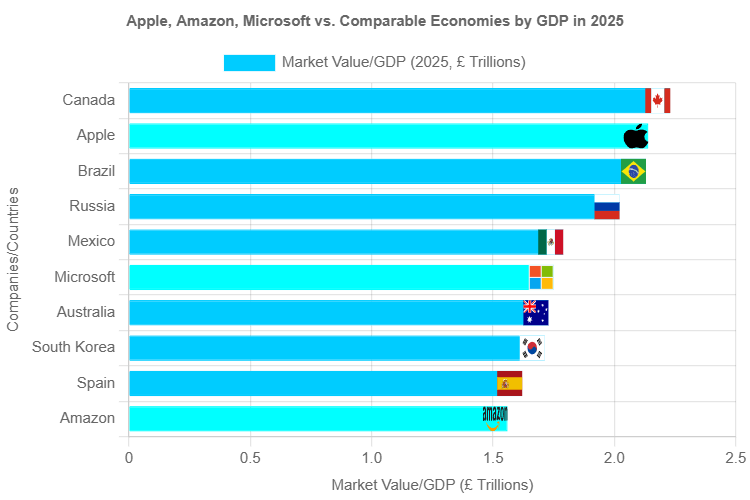
The value of these tech companies often rivals or even surpasses the economies of entire nations. Take Apple for example, which alone is worth around 2.2 trillion pounds in 2025, which would make it the 10th largest economy in the world. This is more than the gross domestic product (GDP) of countries such as Brazil, valued at 2.1 trillion pounds, or even Russia at 2 trillion pounds, as per World Bank estimates.
Microsoft’s cloud services support 40 percent of US government data, boosting its worth of up to 1.8 trillion pounds, that’s more than the GDP of Australia, South Korea & Spain based on World Bank figures.
In Africa, Huawei’s 5G networks cover 70 percent of the continent, giving it a voice in how countries communicate, per telecom industry data. As these companies grow, their wealth and influence challenge nations’ traditional control over economies, raising questions about who really holds power as we approach 2030.
Meanwhile Amazon’s 2025 value of 1.6 trillion pounds vastly exceeds the GDP of developed nations such as The Netherlands, Poland & Sweden. The figures of these tech giants are an indication of how tech firms are not just businesses, but genuine economic powerhouses that can match or outstrip the financial strength of large to medium-sized countries, giving them a huge say in global matters.
How Nations Are Fighting Back
Countries are not letting tech take over without a response. The USA has blocked China from accessing advanced chips, slowing its AI progress by 18 months, according to a 2025 McKinsey report. Whilst China is fighting back with its Made in China 2025 plan, producing 65 percent of Huawei’s devices with homegrown 7-nanometre chips.
The European Union on the other hand has recently introduced its 2025 AI Act, fining companies such as OpenAI 35 million euros for not following rules, based on EU regulatory reports. The EU also has invested 10 billion euros in its Digital Sovereignty Fund, to ensure its support in developing local tech firms.
India is also looking after its own interests, recently spending over 6 billion pounds on 50 new AI startups to stand on its own, whilst smaller nations such as Vietnam depend on Starlink for the internet but face pressure from China to use Huawei’s 5G. Governments are recognising the vast influences of tech giants and are now launching key initiatives to tip the balance of power back into their control.
Key Battlegrounds Shaping the Future
The competition between tech titans and nations unfolds in several important areas, each pointing to major changes by 2030. Let’s take a look…
AI Cyber Warfare Nations
Causing grief online has come a long way since simply giving somebody a ‘poke’ on Facebook. Cyber attacks over time have become more frequent and much more severe and now with the recent adoption of AI, it has become even more of a global threat. In 2024 for example, an AI crafted a phishing attack that disrupted power grids across Europe, causing over 600 million euros in damage.
And these are not just coming from powerful individuals or groups. NATO reports a 35 percent increase in state-backed cyber threats, many using AI to outpace defences, as per their annual security review. Russia for example has been a country of vast cyber attack acquisitions by NATO members, particularly by old enemies the United States and also the UK, who last year reported that over 400GB of NHS patient data was stolen by Russian-backed criminals.
It would be reasonable to expect such cyber attacks to continue, with countries looking to utilise such capabilities to their own initiatives, as the global game of chess by the world’s rival superpowers continues. By 2030, AI cyber warfare could see tech firms leading defence efforts, perhaps acting as neutral helpers or even choosing sides in digital conflicts.
Digital Currency Power Shift

Money is also changing hands, China’s digital yuan, used by 520 million people in 2025 allows the government to track every purchase, challenging the US dollar’s 54 percent share of global trade, down from 70 percent in 2020, as reported by financial market analyses. Meanwhile Crypto giant Bitcoin shows no signs of being simply a fad, as it recently reached 1.6 trillion pounds and powers 22 percent of online transactions according to cryptocurrency reports.
(And to think there’s people out there who owned millions worth of Bitcoin in their old crypto accounts and forgot their passwords, ouch).
Nevertheless, the digital currency power shift looks set to continue and gather pace, further weakening the power of national banks and transforming a new financial landscape.
Data as a Global Tool
Data is more than just statistics, it’s a gold mine. Google handles roughly 3.7 billion searches daily, as per tech industry studies, while social platforms shape 45 percent of election campaigns in 2025, according to Stanford research. Countries are setting in place key legislation to manage data, such as India’s data storage laws and the EU’s GDPR, which fined 1.3 billion euros in 2024 for privacy breaches, based on EU regulatory reports.
By 2030, experts predict tech could control 40 percent of global data, influencing votes and security and putting nations on the defensive.
Infrastructure and Control
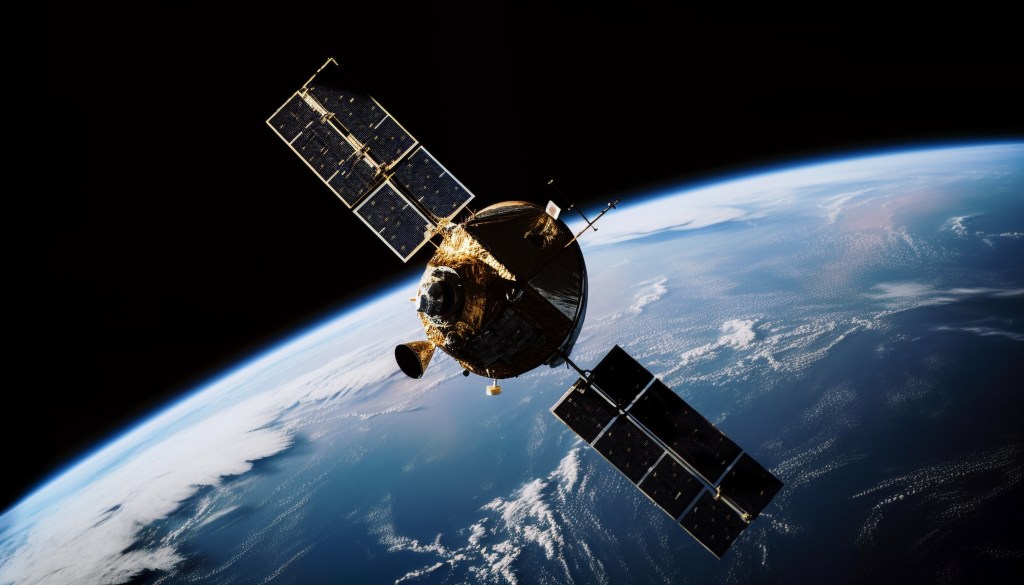
Tech firms are further solidifying their positioning in the global landscape. SpaceX has recently been making noise in its defence contract with the US military. Starshield is a dedicated, military-focused version of SpaceX’s Starlink satellite network. It’s designed to provide the U.S. military and allied governments with enhanced space capabilities beyond what’s offered by the commercial Starlink service. Starshield leverages Starlink’s technology but adds features like target tracking, optical and radio reconnaissance, and early missile warning.
As government funding in Space has dried up in recent years, SpaceX has become the key player and revitalisation of Space exploration, transforming Space technology and with plans of putting people back on the Moon and even Mars (stay tuned for an upcoming article on this).
What Might Happen in the future?
By 2030, tech titans could act more and more like countries, with their own money, data, and cities. Smaller nations might partner with firms like Huawei for tech support, bypassing traditional powers etc. However, risks are real: cyber attacks could cripple nations, data control might sway elections, and 60 percent of 2025’s 160 billion pound AI investment going to five companies could widen gaps, according to global investment reports. Nations need strong tech regulation to balance this, but global teamwork is difficult with the USA, Russia, China, and the EU all competing with one another.
As the digitalisation of the world continues, the battle landscape between tech giants and nations could continue to have substantial implications upon the very world we live in. It might not be long until elections are conducted on the subreddit pages of nations or Tesla is even powering your own town.
Let’s hope they do not make us solve incredibly frustrating CAPTCHAs of either fire hydrants or motorcycles to vote…
What do you think about the way geo-politics is shaping up? Share your ideas below and subscribe to Tales of Tomorrow for more!

 Tales of Tomorrow
Leave a reply to thisismylife00 Cancel reply